
When Women’s Stories Are Optional, Powerstories Makes Them the Point
by Avery Anderson
American theater loves to talk about “universal stories.”
It just keeps telling them from the same point of view.
Despite decades of conversation about equity, women still represent fewer than one-third of the plays produced on professional U.S. stages in a given season. For women over 40, the numbers drop further — not because the work disappears, but because opportunity does. Add race, disability, queerness, or class into the equation, and visibility narrows again.
That’s not a vibe problem.
It’s a structural one.
And it’s why Powerstories Theatre’s Voices of Women Theatre Festival, returning March 5–8, 2026, matters far beyond its four-day run.
This isn’t a showcase designed to feed the pipeline and hope someone important is watching. It’s a corrective — a deliberate rebalancing of whose stories get space, time, and an audience in the room.
A festival born out of crisis — and still pushing back
Voices of Women didn’t start as a branding initiative or a season add-on. It began in 2020, when theaters went dark and Powerstories refused to let women’s stories disappear with the lights.
What emerged from those early Zoom rooms — alongside Voices of Truth and Voices of Youth — was something unexpectedly durable. Voices of Women didn’t just survive the pandemic; it exposed how many playwrights had already been sidelined long before COVID hit.
Six years later, the festival has become an annual reminder that the absence of women’s voices in American theater isn’t accidental — it’s maintained.
What makes this festival different
The 2026 festival presents:
- Three evenings of full-length staged readings, including a category dedicated specifically to women playwrights over 40
- One night of short plays by local women playwrights, grounding the national conversation in Tampa Bay voices
- Seek and Speak Your Powerstory presentations and workshops, where women shape lived experience into performance — and hear it spoken back to them
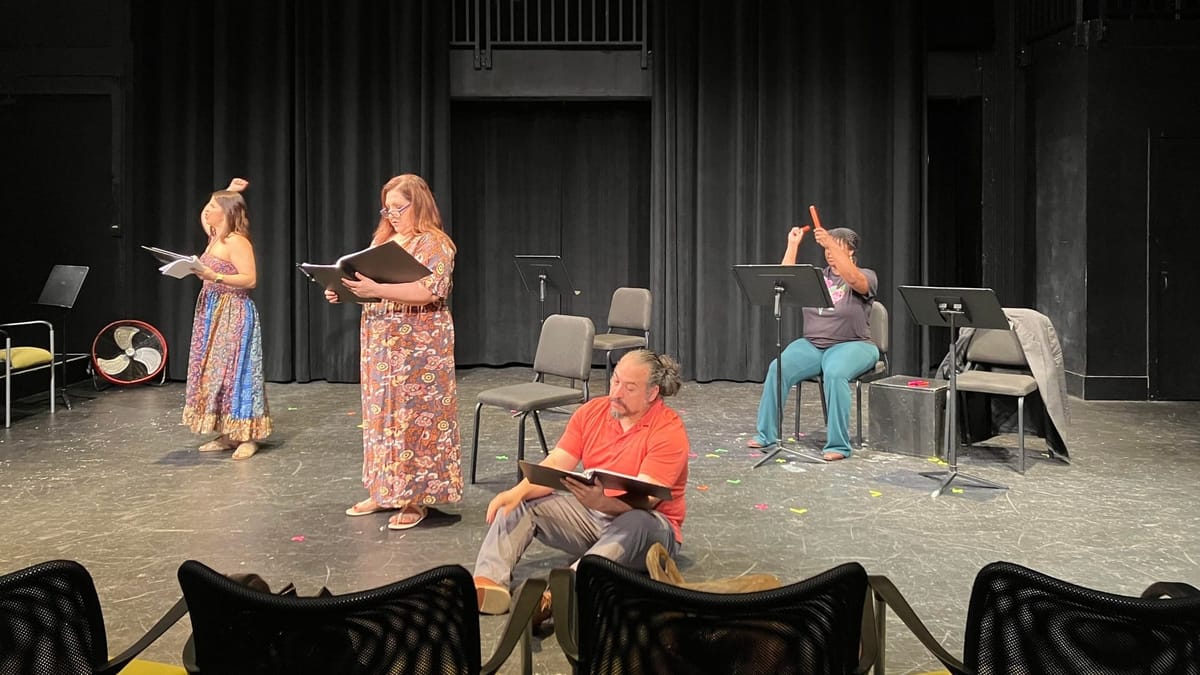
These aren’t “industry readings” designed to be judged and discarded. They’re public acts. The point is not polish; it’s presence.
Hearing a play out loud — in a room, with bodies breathing around it — is still one of the most powerful steps in a work’s life. Too often, women never get that step.
The 2026 lineup puts women back in the frame
This year’s full-length selections include:
- How To Rob the Art Institute of Chicago by Sam Hernandez (Texas)
- The Tragic Ecstasy of Girlhood by Kira Rockwell (Georgia)
- All My Mothers by Shelli Pentimall Bookler (Pennsylvania), featured in the Women Playwrights Over 40 category
Short Play Selections:
- “Love, Lost (Rings), and What We Wore” By Jessica Burchfield
- “Zeus Gets Cancelled” By Alaina Rahaim
- “Black Barbie” By Ashley Burgess Laster
- “What about Ruth?” By Charlene Dorsey
- Seek and Speak Your Powerstory presentations
Saturday’s short-play program spotlights Tampa Bay playwrights with works that range from sharp cultural critique to intimate personal reckoning — exactly the kind of range that’s often flattened when women’s work is treated as a “genre” instead of a field.
Why this still has to be said out loud
Theater prides itself on reflection — holding a mirror up to society. But when most of the stories come from the same demographic, that mirror warps.
When women aren’t produced, audiences lose access to:
- stories about aging that don’t disappear at 39
- motherhood that isn’t sentimentalized
- girlhood that isn’t flattened into nostalgia
- power, violence, faith, and survival told from inside the experience
Voices of Women doesn’t ask whether women’s stories are “relatable enough.”
It starts from the assumption that they’re necessary.
A Tampa Bay answer to a national problem
Hosted at the HCC Black Box Studio, the festival keeps its scale intimate and its focus sharp. This isn’t about spectacle. It’s about concentration — giving stories room to land, and audiences room to listen.
In a moment when arts funding is shrinking and cultural gatekeeping is tightening, festivals like this don’t just fill gaps. They protect space — for writers, for audiences, and for futures that don’t look like the past.
Six years in, Voices of Women has made something clear:
equity in theater doesn’t happen by accident.
It happens because someone builds the room — and insists women belong in it.
If you go
Voices of Women Theatre Festival
March 5–8, 2026
HCC Black Box Studio, 1411 E. 11th Ave., Tampa
$20 single tickets | $59 all-access festival pass