
Inheritance Is Still Happening
Two Guatemalan artists take over The Werk Gallery—and refuse to be frozen in time.
By Avery Anderson
If you walk into The Werk Gallery expecting “heritage art” to behave itself—sit neatly on the wall, offer a placard, and stay politely in the past—you’re about to be corrected.
The Werk Gallery’s first exhibitions of 2026 do something far more interesting. They argue. They insist. They take up space.
From Jan. 2 through Feb. 1, The Werk presents two solo exhibitions by Guatemalan artists living in Tampa Bay—Concepción Poou Coy Tharin and Carlos Pons Paz—whose work makes a shared claim: we are still here, and we don’t need permission to belong in contemporary art spaces.
A tradition that refuses to be decorative
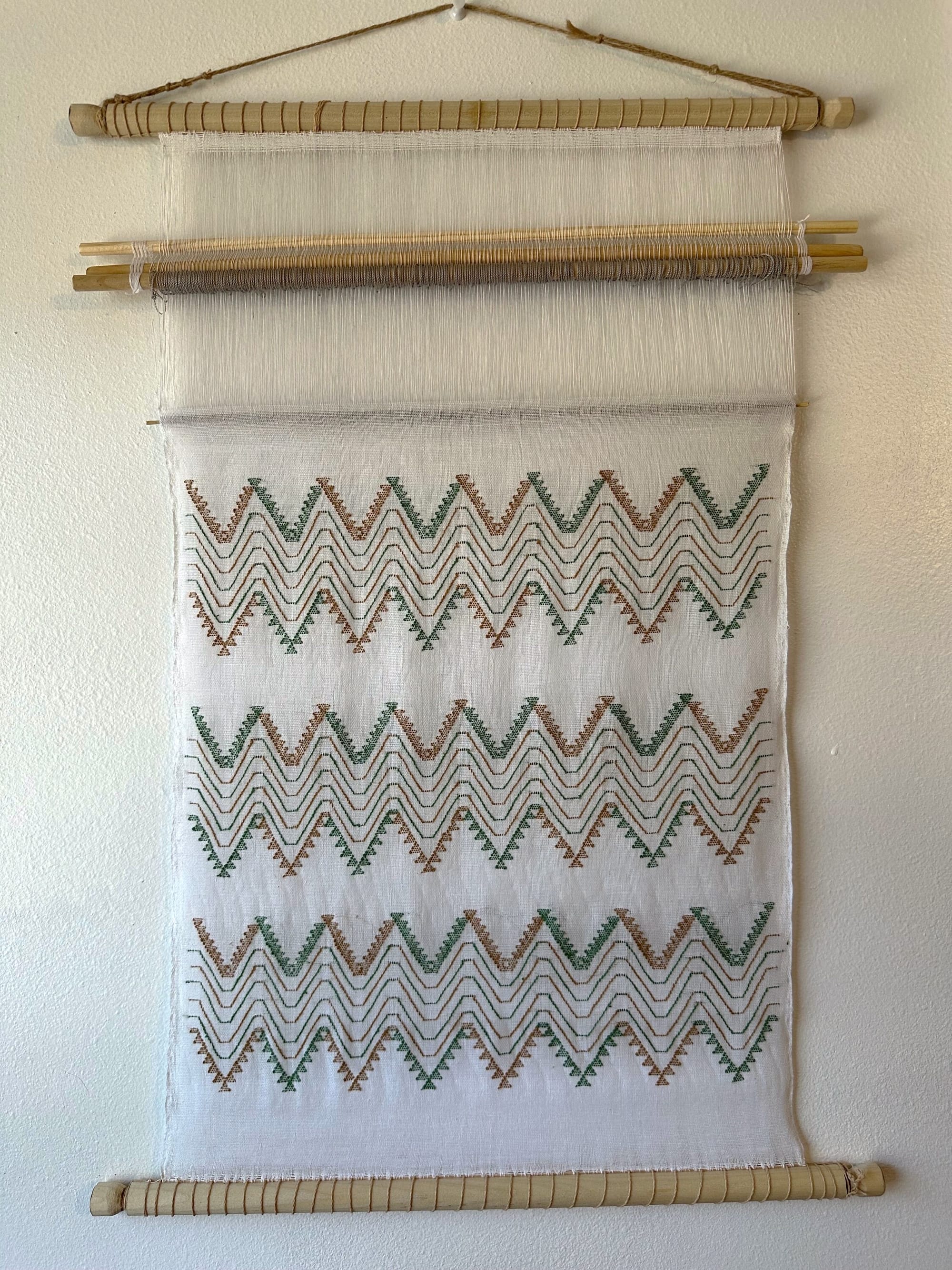
Tharin’s exhibition, Inheritance, doesn’t just hang on the walls. It floats. Pikb’il—an extraordinarily fine, white-on-white Mayan backstrap weave—spills across mannequins and suspends from the ceiling, light enough to feel almost temporary. Which is ironic, considering it’s been practiced for thousands of years.
“It represents not only my work,” Tharin said, “but… the ‘inheritance’ from my family, my indigenous group (the Q’eqchi’ Maya), and my ancestors that were doing this same weaving for thousands of years.”
Backstrap weaving is slow, physical, and unforgiving. A single blouse can take a month to complete. For generations, it has been both cultural preservation and economic survival—often the only source of income available to women in Tharin’s village in Guatemala.
In the U.S., Tharin’s relationship to the work has shifted. She now creates wall hangings, scarves, and sculptural pieces—forms that ask viewers to look at pikb’il as art, not just artifact.
“I guess I think about it more as art than I used to,” she said. “I used to just think of it as a way to earn money.”
But this isn’t about elevating tradition by removing its context. The exhibition includes a working loom, materials, and a video on her process and heritage—because, as Tharin noted, appreciation requires understanding.
“I have always needed to educate people on the process and how long it takes so that they can appreciate its difficulty and beauty more,” she said.
And there’s a deeper urgency beneath the beauty.
“It is important to share it here to remind people that the Mayan people and our traditions are not a long-lost ancient civilization,” Tharin said. “We are still here, and we will continue to be here, and our cultural heritage has value.”
The space between belief, memory, and becoming
Just steps away, Pons Paz compresses an entire emotional universe into The Werk’s Gabinetto Segreto—a 90-square-foot room that feels less like a gallery and more like a private reckoning.
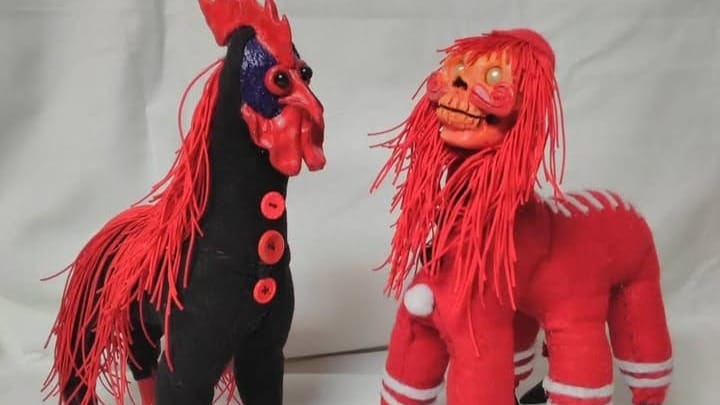
Two mural-scale paintings engulf the space. Small fabric-and-clay figurines—suggestive of votive objects—stand quietly nearby. The work doesn’t explain itself, and Pons Paz isn’t interested in making it do so.
“I don’t think much about who the work is for,” he said. “I’m more interested in understanding myself.”
That self-examination is shaped by lived experience. Pons Paz moved to the U.S. from Guatemala at 11 and spent part of his youth undocumented—an experience that continues to surface in his work, if not always visibly.
“Some of the imagery carries struggle, pain, fear, and limitation,” he said. “Those experiences inform the work beneath the surface.”
Religion, intuition, and vivid dreams all feed the imagery. While creating this body of work, Pons Paz said he was “circling that personal center”—a place where memory, belief, and instinct converge.
“Making it brings me closer to the source, or what I understand as God,” he said.
If that sounds abstract, that’s the point. The goal isn’t comprehension. It’s attraction.
“I hope they feel intrigued first,” Pons Paz said. “Maybe even a quiet sense of excitement.”
Why this pairing works
Together, these exhibitions reject a familiar trap: the expectation that artists with immigrant or Indigenous roots must either explain themselves endlessly—or remain frozen in “tradition.”
Tharin insists that Indigenous textile practices belong fully in the contemporary art world. Pons Paz insists that personal transformation, displacement, and faith don’t need to resolve into tidy narratives.
Neither is offering a history lesson. Both are making something alive, present, and unresolved.
Which feels exactly right for the start of a new year.
The exhibitions open with a reception Jan. 2 from 5–9 p.m., followed by artist talks Jan. 24 at 1 p.m. And while you can walk through the gallery in under an hour, you may leave carrying something heavier: the realization that inheritance is not something you look back on. It’s something you’re standing inside of—whether you’re ready or not.